Thursday, July 10
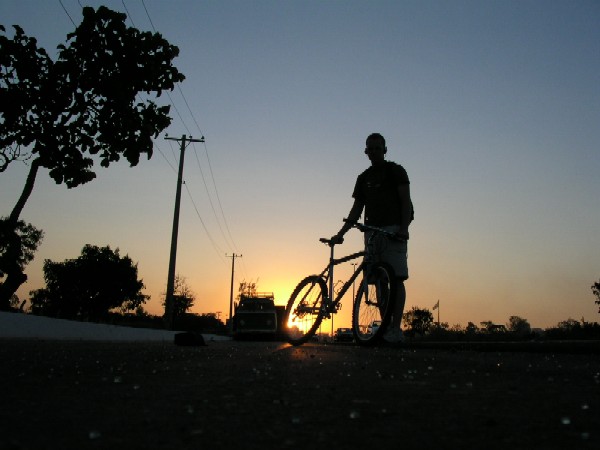
On the way home.
Work has picked up quite a bit. I'm working on a number of projects now and I also started a little research on Brazilian gun control. It's good to be active and learning. I got to talk to the Norwegian embassy today. It's fun doing the diplomat thing, the whole idea is to be nice and try to be treated nicely in return. I just wanted to talk a bit about the Norwegian Prime Minister's recent meeting with Brazil's President Lula, so that's what we did. It was great! I've got to make an effort to get out of my corner and talk to people more. It seems that's the game down here anyway, people just read the paper, stay up to date and talk to each other all the time. Not bad.
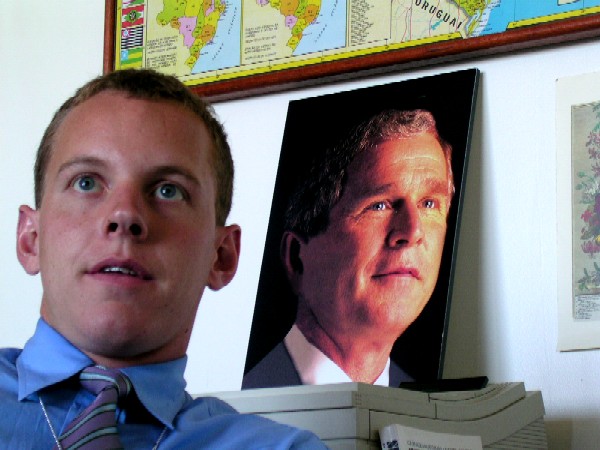
The Commander in Chief and me.
Most of the people that I work with are democrats and they didn't know what to do with the sweet picture of President Bush seen above. I walked into my office this afternoon to find the political section secretary, Sally, putting the picture up in the conference room that I work in. I'm somewhat partial to Bush, but I'm not a huge fan, especially in light of his recent wavering on his reasons for invading Iraq. Anyway, he's in my office right now, but I took him out of my direct line of sight, the picture is just too funny.
Music listened to while writing: Lily's Selected and Modest Mouse's Lonesome Crowded West
Wednesday, July 9
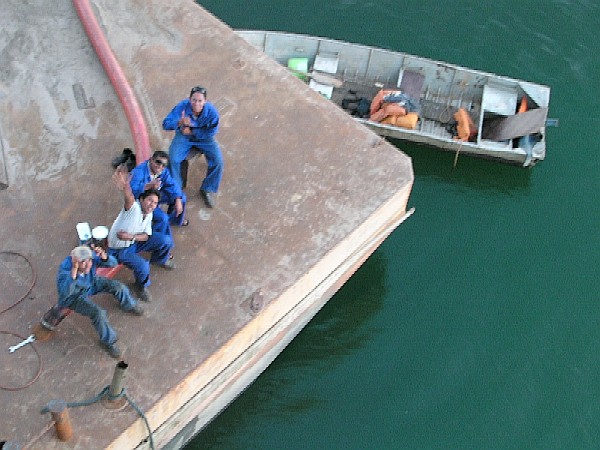
Under the Bridge, Brasilia
It's been good to be back in the embassy. As my gargantuan last post might indicate, I had a very full weekend, and it's been good to put my headphones on and bike around sleepy Brasilia again. Unfortunately, I have found out that this site is being scoured in search for rumors to be spread around the embassy. I maintain this journal for the benefit of my family and friends, but as the saying goes, "if you've got nothing to hide, why hide it?" I don't harbor any secrets and I generally don't hide anything, but if anybody is looking for dirt on me, they'll find it if they look hard enough; I'm far from perfect. Anyhow, I find it odd that people that I don't know would be so concerned about my life, but it's bound to happen and I can't expect any privacy on the internet. So in conclusion: if anyone has any comments about what I write, my email address can always be found in the column on the right side of this page. Drop me a line; I'd be happy to talk.
So, my tasks are mounting. I get to write the official report on the seminar in Belo Horizonte. What's more, I get to write a little commentary as well. It's my own official piece of history. I've been considering pursuing a career in energy policy so I dipped into the USAID energy policy expert's office to chat a bit about what he did. Maybe I was tired, but I wasn't as interested as I thought I would be at first. That worried me because I think that the development of sound energy policies is the most pragmatic way to develop useful environmental policies and I loves me the environment. Anyway, my hope began to falter, but suddenly I started getting interested again. It sounds like interesting and certainly useful work, I'm going to work with the officer over the next few days and I should have a better idea about my career choices by the end of the summer. The problem that I'm faced with is the fact that I don't like offices. I like people and I think I'm going to need a job that requires me to talk to a lot of people all the time. That's what I think, but I'm sure there's room for that somewhere in energy policy. I mean, it's politics, the word has its roots in the Greek word for citizen, as does metropolis. It's all about people.
Other than that, the bike is still awesome, and I go to sleep really early. It feels great. It's hard to realize that I've barely been here for a month. I'm beginning to feel quite at home. I've got a list of people around the embassy that I want to talk to about work and I start official Portuguese lessons tomorrow. Beleza!
Music listened to while writing: Sonic Youth's Washing Machine and ...Trail of Dead's Madonna
Tuesday, July 8
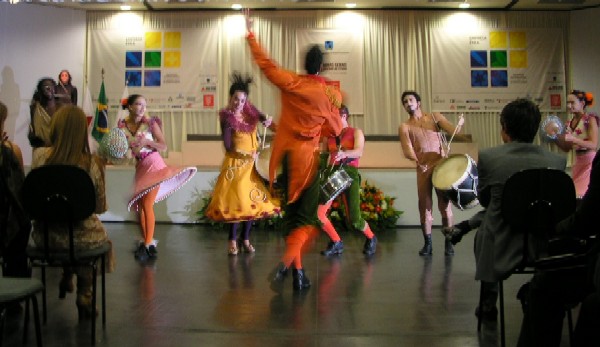
Samba Phantasmagoria 2003
Homage to Minas Gerais
A week ago my enemies rejoiced at my misery! And as of Saturday night I found myself marveling at the perfect state of my life while standing under a clear starry sky at a gas station on the outskirts of a little town called Ouro Branco (White Gold). It was cold and my good friend Gaby asked me if I felt the same way he did: that it’s wonderful to be out in the middle of nowhere. It certainly is, but I’ll describe the scene later after I tell you how I got there.
A week ago my camera had been stolen, my heels bruised, a toe skinned, and my hand wounded by an accidental self-stabbing with a plastic fork. It’s hard to get lower than that, but that’s a good thing because I had nowhere to go but up from there. I got a ride into work on Wednesday, having left my bike at the embassy. After a decent day’s work, I took my luggage and myself downstairs to get in one of the embassy’s cars to head to the airport. I was headed to a city called Belo Horizonte (the capital of the state of Minas Gerais) to attend a seminar about corporate social responsibility. The late-afternoon sun shot across the lake onto the houses and hills to the east as my chauffer, Charlie, drove south towards the airport. We talked about the differences between American and Brazilian party politics and discussed a bit about how a few Brazilian senators are being kicked out of their parties. I realized that I had passed a litmus test of sorts because I was able to talk politics in Portuguese with a Brazilian. I guess I’m beginning to get the hang of things after all.
I spent the flight with my nose buried in The Count of Monte Cristo. I can’t seem to get enough of that book. I managed to read something like 250 pages of it over my trip and you can assume from this point forward that if I had any spare time, I pulled the book out. If I hold this pace, I’ll be halfway done with the book by Christmas. The thing’s HUGE! It was dark by the time that I got to Belo Horizonte and I didn’t get to see much as the taxi carried me to my hotel, but I did get a feel for the area. The stretch of city between the domestic airport and downtown is pretty seedy. The streets twisted around buildings, over bridges and seemed to turn into highways for a short stretch only to turn into city streets soon after. The driver shot past motorcyclists and buses, weaving around non-motor cyclists and pedestrians all the time. The radio softly played “Love‘s Theme” by the Love Unlimited Orchestra as I sat dumb in the back seat, completely oblivious to the fact that the song’s author, Barry White, could have been dying at that very moment. My hotel, the BH Palace, was suitable enough. I’m used to hosteling, so it takes a pretty ghetto arrangement for me to complain, but I can comfortably say that the BH Palace is a really crappy hotel. I had a big lumpy bed, two lumpy pillows, a TV with buzzing speakers, and a warm shower. Nothing was necessarily well presented or well taken care of, but it was all there, so I can’t complain. Actually, I had a mini-bar too, so that’s worth mentioning even though I only bought a chocolate bar and a bag of chips from it before I realized that they were part of the mini-bar and not just complimentary snacks.
My friends who had helped organize the event were busy at an official dinner that night, so I was forced to go alone. No problem. I changed out of my work clothes and hit the streets in jeans, soccer jersey and flip flops. When I’m alone and can eat whatever I want, I tend to lose my appetite because I’m so overwhelmed by options. The factor that decides what I’ll eat is how cheap and how non-terrible it is. I walked a few blocks and found a hot dog vendor fiddling with his cart. I asked for two hot dogs, but he was just setting up for the evening and told me to come back 15 minutes later. So I walked further down the street and came across a narrow restaurantesque establishment with two drunken street-roaming musicians performing outside. It’s hard to explain, but the place isn’t quite a restaurant, but it’s the sort of place that one can go to for a snack. They have fried meat pies and other such pastries, they have a freezer full of ice cream bars, they have soda and beer. Anyway, the clientele were all busy listening to two men perform some of the most authentic music I’ve ever heard. Once again, I’m at a loss for words, and authentic is all I can come up with now. It seemed so real, although surreal at the same time. A lighter-skinned mestizo looking man lazily played a chord progression on a classical guitar while a very dark-skinned man played a ukulele with astonishing dexterity. His hands were enormous, each one nearly as large as the body of the ukulele, and his fingers floated up and down the small neck of the instrument while he plucked out a tune as fast and happy as an old rag-time piano piece. But what was most striking was how sad he looked while he played. His bloodshot eyes drooped focusing on his hands, his face sullen, his mouth frowning, all while he played such a carefree ditty. I stood transfixed until they finished, gave them 1 real and kept on walking. I didn’t feel like eating any fried pastries.
I kept walking until I found a little restaurant on a corner. It was one of those run down places that are run merely to pay the bills and they didn’t have most of what was on the menu. I ordered a burger and ate it at a table outside while two lovers held each other at a table behind me. A large group of people played some sort of game at another table and two girls about my age split a liter and a half of beer at the table in front of me. A guy walked by carrying a large tin canister, like a large vegetable oil can, with holes cut around the sides along the bottom. It was full of red-hot coals that heated packages of nuts rolled into cones of paper placed in holes in the top of the canister. If I carried anything like that around, I’d burn the crap out of my leg at least every five minutes. Anyway, the nut vendor amazed me. I finished my burger and headed back to the hotel, but I got a hot dog along the way.
The hot dog dude is the kind of person that, given the right opportunities, could be all-powerful. He and his wife/assistant (I couldn’t tell) were happy to see me return and they quickly set to prepare my second dinner. So here’s how a Minas Gerais hot dog goes: the bun is placed in a plastic bag, the hot dog is taken out of the thin tomato sauce that it is cooked in and placed in the bun, a shoestring potatoes are heaped on top, then shredded carrot, then corn, then raisins. Hey, whatever, I’m down for whatever. The guy covered the whole thing in mayonnaise and handed it to me. I didn’t know what to do, not because I didn’t want to eat it, but because I didn’t know where to begin. I couldn’t see the hot dog at the bottom of the bag. The hot dog selling couple got a kick out of my confusion, but I quickly decided to give it a go. It didn’t taste bad at all, but it wasn’t a taste sensation worth getting excited about. I stuffed it down and talked to the couple. The guy was a director at a capoeira school during the day. I tried to tell him that American break dancing has its roots in capoeira, and he only slightly agreed. Anyway, we talked about staying in shape, about American food, about Belo Horizonte and Brasilia. It was really nice, I was very impressed with him and, like I said, I feel like he could go far. His enthusiasm for life seemed boundless. We both agreed that it is important to keep an attentive ear and open eyes while walking through life. So there I was that night, eating a corn and raisin laden hot dog at an intersection in a less-than-blinged part of Belo Horizonte and sharing a sublime moment of truth with the man that sold it to me.
My wake up call got me up the next morning and I only had to walk a few blocks to the convention center. I met up right away with my friends from the Inter-American Development Bank: Alan, Gabriel and Mariana. Alan had brought my replacement camera with him from Washington. My dad had given it to him the day before he left (the day it was stolen). The seminar kicked off with a sort of bang. That is, it was surprising to see such a large crowd of businesspeople gather to hear so many talks on ethics. Nobel laureate Amartya Sen prepared a video of a talk that he prepared for the seminar in which he discussed one of the main pitfalls of social capital that I have observed: it can lead to exclusion. The point is that if something is to be regarded as capital, it needs to be a resource that is available to everyone. However, the secondary institutions that promote solidarity and governance among one community will almost always promote such solidarity at the expense of another group. Anyhow, he articulated the problem very well. He was followed by a Norwegian theologian who spoke of the necessity of dignity and justice in our economy. He also discussed how vulnerability is an essential human characteristic and that attempts made to make ourselves invulnerable make us less human. It’s an interesting argument, and I won’t bore you with it here, but I’ll think about it and I might write something on it later.
After the first plenary session, the official opening of the seminar began. The Prime Minister of Norway was there and he spoke for a long time. I was surprised to find out that he had been a pastor before becoming prime minister. I had been under the impression that all of Europe, northern Europe in particular, was an entirely godless place where any mention of deity was scoffed. He didn’t flinch at all as he discussed the need for Christian values to be regarded throughout policy development. He also reminded me of a great concept that I had been taught by the Jesuits at my high school: stewardship. The idea has its roots in God’s instructions to Adam and Eve, in which he explained that they were to care for the earth. That one rings true to me. President Lula spoke as well, but he didn’t have much to say. He was careful to thank Norway for their support of Brazil and was eager to call on other “rich countries” (his words) to help pick up the slack as they hadn’t done so previously. Whatever, I’m optimistic about Lula, his policies seem sound so far even though he wasn’t the greatest (or well prepared) public speaker I’d ever heard. It’s important to keep in mind that Lula never even graduated from high school. He shined shoes in the streets as a child and worked his way up through labor union leadership before becoming president by winning his third (or fourth) presidential campaign. Props to Luis Ignasio Lula da Silva! Oh yeah, he also sounds like Captain Caveman with a lisp.
I won’t bother with details of the rest of the seminar, but I’ll say that it inspired me to do something with myself. Details will come later, but I’ve got an idea of how to encourage corporate social responsibility and I’m going to give it a go.
I snuck into a fancy dinner that night with by bank friends. They had an extra invitation to the dinner and I got in without much trouble. The only hitch was that I had to give them the invitation and my name at the door. The invitation that I had was intended for a guy with a ridiculously unpronounceable name and I just fudged my way through the whole thing, mumbling my fake name until they didn’t bother to ask anymore. A jazz band played Getz and Gilberto’s hits (Girl from Ipanema, So Danza Samba Vai Vai Vai) and I hobnobbed with the economists, with my old friend Rebeca Grynspan (former vice-president of Costa Rica), with a cool old Norwegian translator named Bill, you know...I networked. Seriously, Rebeca Grynspan is one of the coolest, nicest ladies I’ve ever known. I picked her up at the airport in Buenos Aires when I was working down there last September and I didn’t know who she was. I chatted with her as we rode in the taxi from the airport and I tried to figure out what she did in Costa Rica (she works for CEPAL in Mexico now), but she wouldn’t let me know. It wasn’t until later that I found out that she had been vice president. What a great lady! She got a kick out of that, and I didn’t feel too stupid because it’s easy to tell how genuinely nice and modest she is.
When it came time to eat, Gabriel, Alan, Mariana and I sat at a table with two hot shot Brazilians and the Norwegian theologian. One of the Brazilians was the president of the Brazilian Worker’s Party in Minas Gerais and the other was a big wig at the Minas Gerais office of a large Brazilian bank. The Worker’s Party guy didn’t take too long to get a little tipsy and start talking about how the ‘best dialogue ever’ is from the first Matrix in which it is revealed that humans are a plague that merely set in on a plot of land, waste its resources and then relocate. It was nice to see that a civil servant had such a high opinion of humanity and that his opinion was so influenced by a science fiction movie. But then again, who knows? He (and/or The Matrix) might be right. I spent most of my time talking God with the Norwegian. It was a great conversation. He explained the renaissance of religious thought in Europe and we talked about the perception of Europeans towards religion in America. It goes like this: I met a few Swedish girls while traveling in Thailand back in January who thought that all Americans were fat honkies who did nothing but go to church (No kidding, one of them asked us in all seriousness: “are Americans really that fat?” Of course I didn’t know what ‘that fat’ meant so I didn’t know what to answer.). Silly stereotypes aside, forgive the digression, here’s what he explained: religious rhetoric isn’t thrown around lightly in public discourse in Europe. He told me that Europeans are quick to point out the similarities between the language that Bush uses (axis of evil, evildoers, God bless America) and the language that Bin Laden uses (great white satan, infidels, Allah bless Islam). Fair enough, there might be comparisons, but that doesn’t mean that one isn’t right and the other wrong. Anyway, in Europe, such speech isn’t generally accepted in public discourse, as 20th century Europe was hit pretty hard by dogmatic rabblerousing.
The second day of the seminar focused on the experiences of socially responsible corporations throughout Brazil and Latin America. It was interesting enough, but nothing struck me the way that the first day's presentations did. There were far less people in attendance, as Lula wouldn't be there to speak. The whole thing wrapped up nicely and we were treated to an acrobatic modern dance samba acid fest as dessert. Yep, the same dance troupe that performed the day before came back wearing dark blue crushed velvet leotards and...well, if you’ve ever seen any modern dancing, you know what I’m talking about. It was interesting, if nothing else, and they also had a smoke machine. The whole thing ended with a full on samba freak out and there are few things that I like more than a whole bunch of people wailing on a whole bunch of drums. I loved it. I got out of my hotel and went to the hotel that my bank friends were staying at. Gaby had an extra bed in his room so I stayed there. We hooked up with a bunch of people that had spoken in the seminar and went to dinner at a churrascaria (Brazilian grill with phat salad bar and a steady stream of waiters bringing grilled chicken, pork and beef on skewers straight from the fire). It’s fun to dine with such thoughtful people. I spent most of my time conversing with two Peruvian women about free markets and the role of government. It’s frustrating to tackle such weighty topics because there are no clear answers, but the debate seems worthwhile and it’s always interesting to hear what other people have to say about things.
We went ‘out’ after dinner. Interestingly enough, after two days in Belo Horizonte, I still hadn’t really seen the city. It was night when I got there and all I got to see during the day was the few blocks between my hotel and the convention center. We took a cab up to a neighborhood in the hills where houses, bars, clubs and other business seem to be intermixed indiscriminately. Mariana had flown out to Sao Paulo that afternoon so it was Gaby, Alan and myself joined by three speakers in the seminar. They were all significantly older than us but it was cool to have them along. None of them were interested in going to the club that we had planned on going to because: a) they’d feel stupid and b) it sounded like they were playing techno in there. We found a funky little place with an open-air patio with a three-piece bossanova/rock band playing. The music was great, very, once again, ‘authentic’ and totally original. I’m a big fan of the simplest bossanova around: a snare drum playing rim shots, a classical guitar and a subdued voice, but these guys had a big drum set, a six string electric bass and a classical guitar. Plus the singer wasn’t too chilled out.
Now, Belo Horizonte has some strict drinking laws. I’ve never seen anything like it. When you enter a club, you are asked for ID and given a card with a list of the drinks, cigarettes, and food that is available in the bar. Whenever you order something, it is marked on the card. When you want to leave, you hand in your card, pay for everything on it, they stamp the card and you hand it to the bouncer at the front door as you walk out. What does this have to do with enforcing the 18-year-old drinking law? I have no idea; although checking for ID at the door is a good start.
Our old colleagues left, they needed to catch flights to their homes of Guatemala, Chile and Colombia the next day. By the way, the Guatemalan woman was the most striking (ahem, hot) woman with a child my age that I’ve ever seen. She didn’t look old at all and I was floored to find out that she could have been my mother, but yeah...anyway. Gaby, Alan and I went back to the techno club with a girl that had organized the seminar named Patricia. We spent the rest of the night in there, dancing to everything from Kylie Minogue to Michael Jackson to ABBA to Van Halen. A kid named Guillermo who had been working at the seminar was there too and he took it upon himself to get as many busted girls as he could and tell them that there was an American there who wanted to talk to them. It was terrifying. I was traumatized most by one who Alan nicknamed Godzilla. I thought she looked more like a Critter, but either way all I saw was a huge smiling mouth full of braces all up in my grill. I couldn’t shake her and every time I turned around she was right there trying to talk to me in English about how she’s going to move to Germany or something. I felt terrible but I had to ignore her, she was way too aggressive. Thanks Guillermo. We stayed out until about 4am. We had to get up at 9 the next morning.

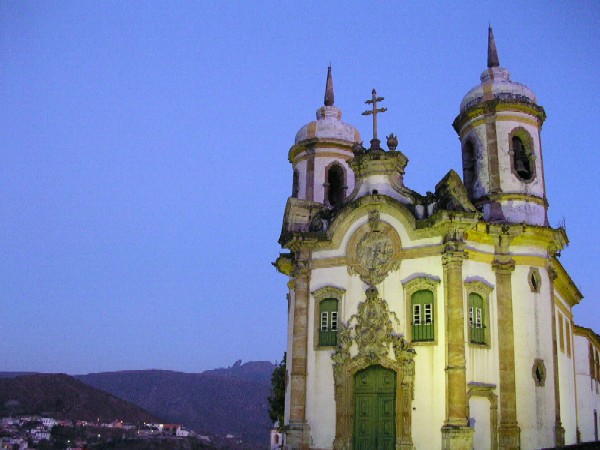
Ouro Preto (Black Gold)
Patricia met us at the hotel and we all took off for Ouro Preto. We had rented a crappy little Fiat and tore out of the city into the hills around it. It was the first time I got to see the city. Visually, it has very little striking architecture. It has a sort of Baltimore run-down feel/charm to it, but I didn’t notice any contemporary buildings worth mentioning. What’s nice about the city are the tall hills that surround it. They slope high above the city, but the city sprawls on up with them, slums on some and fancy apartment buildings on others, the buildings cling to the steep sides all the way up. We cruised across the rough highway for a few hours before finally pulling into the cobblestoned streets of old Ouro Preto.
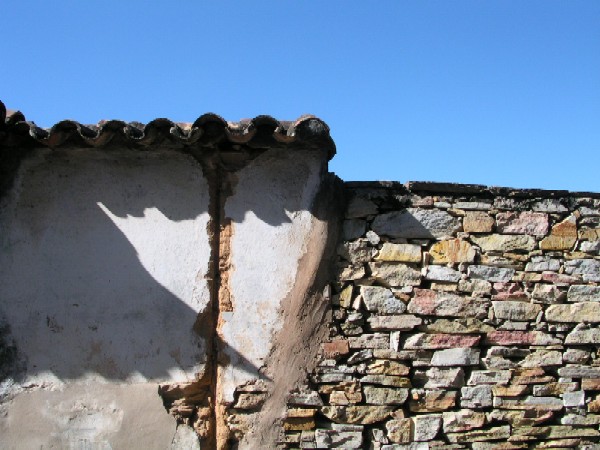
Colonial
Ouro Preto is a colonial mining town turned tourist spot. Its history is a bit sordid, in it’s prime it was run by slave-owning Jesuits. I was surprised to see how much the African-Brazilian slave culture seemed to parallel that of the slaves in the United States. For instance, we ate a phenomenal pork and bean stew called feijoada for lunch. Along with the feijoada, we ate collard greens, ochre, and other salads. I guess it’s the collard greens and ochre that strike me as ‘soul food’ and it surprised me to encounter them down here. However, the typical image of a slave woman in town was the standard bandana wearing smiling housekeeper. Interesting. But the saddest thing was how the misery and cruelty were identical, depicted in paintings and carvings of shackled and tortured men throughout the town. As President Bush just said, slavery is one of the greatest crimes of history.
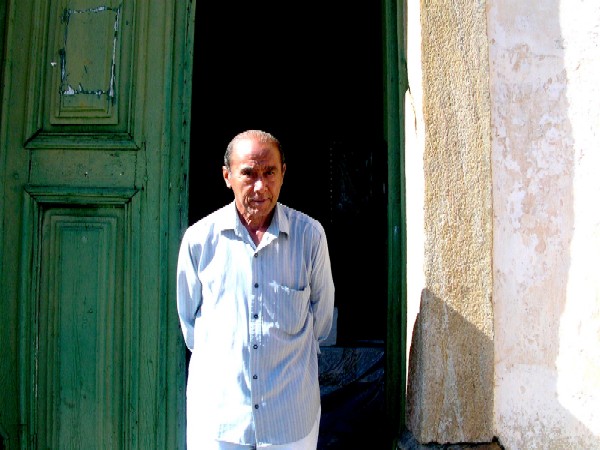
Curator
Before lunch we visited one of the 11 churches found throughout the city. The man pictured above showed us around, explaining the paintings, the statue of the virgin with two prisoners at her feet, the saints who died terrible deaths (one was grilled, another was sliced up by a wheel with knives affixed to it as a punishment for disobeying her father and wanting to become a nun instead of marrying).
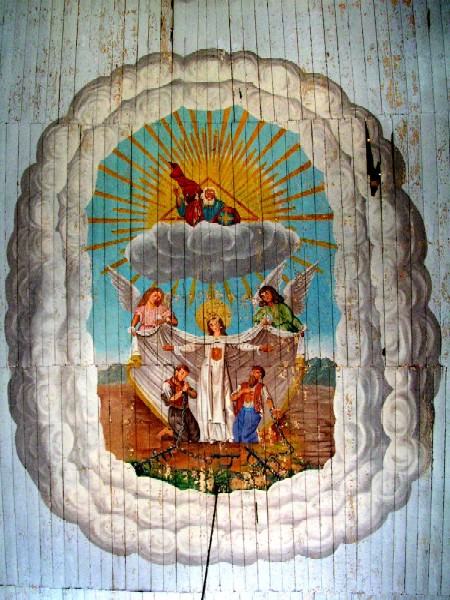
Ceiling of the church
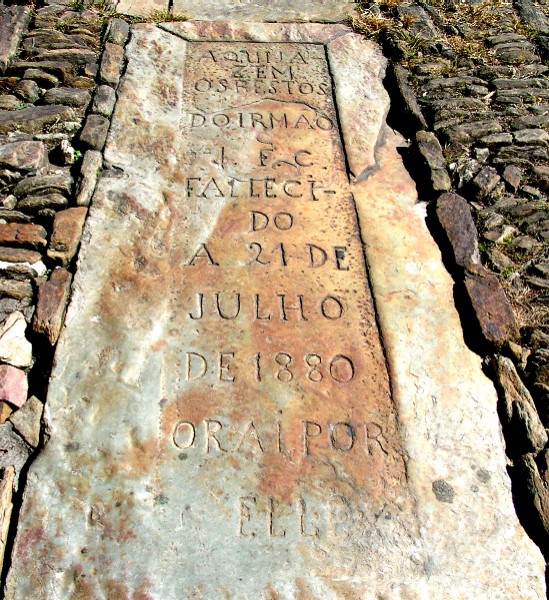
Here lie the remains of brother I.F.C. who died on July 21st 1880. Pray for him.
He told us about the interesting side entrance to the church, where all who enter step on the grave of an evil man. We asked him what was so bad about him, what had he done? The answer was that if there was anything bad to be done, he did it.
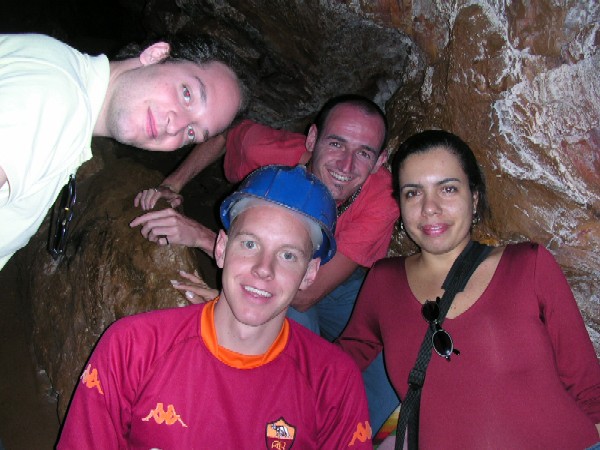
Horizontal Alan, Me (safety first), a Basque dude, and Patricia in a gold mine
From the church we wandered down through the steep streets and stumbled upon a mine. We had to go through a house to get to it. We paid our 5 reais, walked through the house to the back patio and made our way underground. We walked through the emptied gold mine with a guide who told us about the slaves that would smuggle gold in their hair (I don't know how) and how one slave in particular came to own the mine after the Jesuits had determined that there wasn't any more gold to be found. We hiked back up the hills to where we had started our visit and then Patricia led us back down the other side of the hills past countless jewelers and restaurants to a restaurant tucked away down a side street. This is where we ate the aforementioned lunch. The service was great, we paid 18 reais (about $6.50) for all you can eat feijoada, squash, salads, fruit, roasted chicken, roasted pork, dulce de leche, some sort of coconut dulce de leche and who knows what else? We stuffed ourselves with our late lunch and quickly got tired. I began to feel a hint of ecstasy, well no, not a hint. I really felt wonderful. It was great to be with those friends, it was great to eat such good food, it was great to be in the mountains and breath the autumn air, it was great to look around the old restaurant at the colored glass bottles, old photographs and other artifacts of its history. I felt so good, it's impossible to describe.
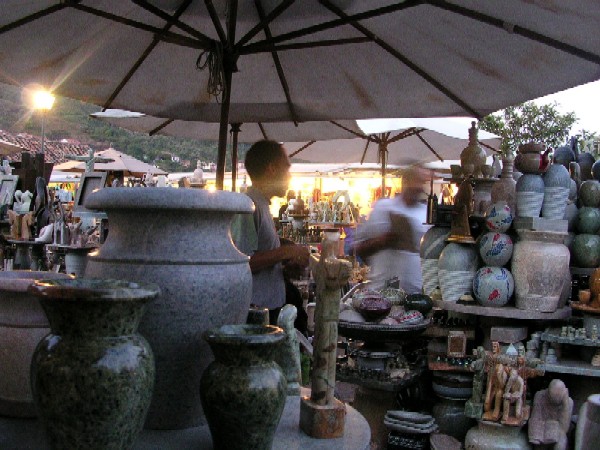
Soapstone Symposium
We walked back up the steep streets to a market full of soapstone vendors. I bought a few pieces for a total of 10 reais ($3.80) and we took off for the town where we'd spend the night: Tiradentes. We got a little lost as we drove out of the city, and after we had driven about 7 minutes out of the city a car passed us, beeping at us and pulled over in front of us. Nobody knew what to do and there was a brief debate about whether or not we should stop. We ended up stopping and the driver of the car that had stopped told us that he was a friend of the person in the plaza in Ouro Preto that had given us directions to Tiradentes. What? We had no idea how this guy had found us or who he was, but he told us to follow him because we were going to wrong way. We figured it would be alright because he had his family with him in the car. So, with a bit of apprehension, we followed him through a neighborhood, up a hill, past some corner bars until he pulled over and bid us to continue. So we did, all of the sudden we found ourselves on a country road that seemed to head in the right direction, up and down hills, around curves, along the unlit road, past hills glowing with occasional brushfires. We drove for a long time before we came to Ouro Preto's sister city, Ouro Branco (White Gold). We stopped at a gas station just outside to use the restroom and buy some water. It was there, in the middle of nothing, under a clear black star-filled sky, breathing the cold oxygen, that Gaby asked me how wonderful it was. It makes my heart skip to even think about it. Little kids from the nearby slums rode around the pavement on their bikes. A man was shaving at a sink in one of the mechanics rooms that we mistook for the bathroom. The little town silently glowed down the road, and I just stood there breathing for a while, but it was time to get back on the road. We had a long drive ahead of us.
I'm going to digress just a little bit here, but the greatness of that Ouro Branco gas station epiphany owes a bit of its strength to my friends. I had some great friends with me on that trip, but I'm lucky to have some great friends at home and elsewhere. It's a wonderful thing to be so far away, to feel that I was exactly in the middle of nowhere, and to be able to think of people that I love and feel so loved in return. I wouldn't be able to be so happy without them. I'd be happy, but I wouldn't be as happy.
The roads kept twisting and we kept driving, passing brushfires that burned in the middle of the black landscape outside of the car. I was losing hope, I didn't see any signs for Tiradentes anywhere, and I wasn't sure if we were really on the right track. But we kept on keeping on, and after getting lost and asking for directions a few times, we finally found our way to the road to Tiradentes.
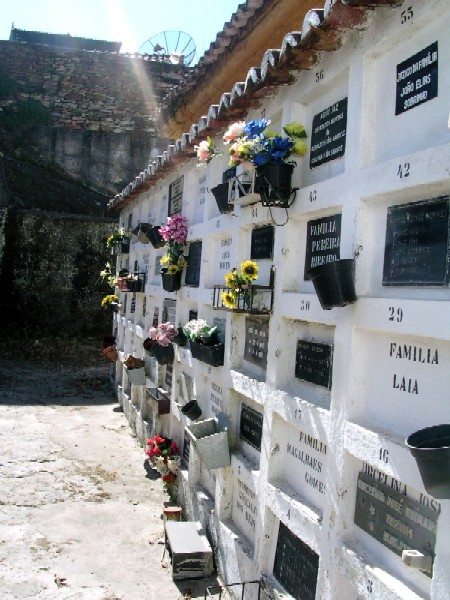
Cemetary
The road got worse, then it turned to dirt, then it turned into something like cobblestones, but not quite, more like pieces of slate and chunks of stone laid down to make something sort of flat for wheels to roll over, but perfect to trip on. Tiradentes (literally 'toothpuller') is another colonial town famous for being the birthplace of Brazil's revolt against Portuguese rein. A man dubbed Tiradentes because of his profession as a dentist lived there and studied the philosophies that inspired the French revolution: liberty, equality and brotherhood. He himself became inspired and he was able to rally others to the cause. Now the town is another tourist spot. I wasn't sure what to think of it when we arrived because it was totally dark and it was freezing cold. We found a hotel with five beds: two pairs of bunk beds and a queen-sized. Patricia got the queen and the boys got to pretend that we were at camp. We also had a huge sauna, but it didn't work. The place was kind of odd, but that's fine with me because the night only cost me about $15 and that included a phenomenal breakfast. Anyway, we left our stuff there, stretched our legs and set out to see the city and find dinner. The clear air didn't soften any of the bright street lights and the stone streets and brightly painted stucco walls were cast in bright light or dark shadow. The sky was clear black, the lights blinded me to the stars. We shivered through the streets and eventually decided on an Italian restaurant. It was late, we left the restaurant at around midnight. Gaby and I wanted to go back to sleep (I wanted to read The Count of Monte Cristo), but Alan and Patricia went to a bar.
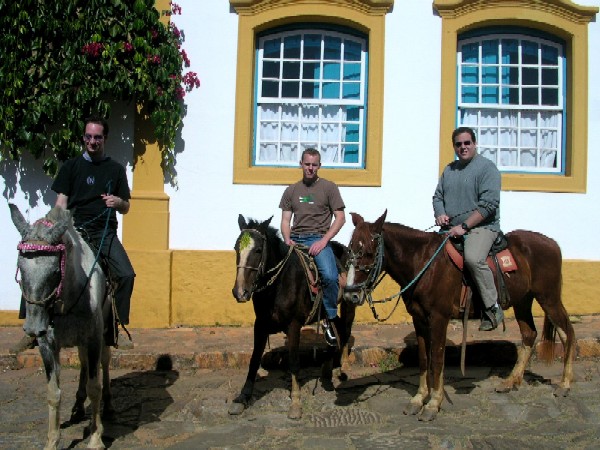
The Freedom Riders: Alan, me and Gaby. Song courtesy of K Records
After a great breakfast (someday soon I will write an homage to pao de quiejo: Brazilian cheese bread), we headed straight to the local rent-a-horse where 10 reais ($2.80) bought me an hour on the horse that I came to call Captain Picard. The Captain is the most stubborn horse I've ever been on. The only time that he didn't need constant prodding was when it was apparent that he was going home. I don't blame him, it must suck to have someone ride on you all day, but hey, that's what he gets paid for...isn't it? Whatever, Captain Picard had a rough time, I had him take me up the steep hill to ride by the town's principal church and he actually slipped a little on a flat piece of slate. No one was hurt, but I felt bad for the fellow. Anyway, we spent a good hour riding around town, wishing the citizens well and so forth. At one point while riding through the non-touristy outskirts of the city I could see a bakery in the distance called Mister Pao, but my eyes deceived me and I thought that it said Mister Poo for a moment. That was pretty cool.
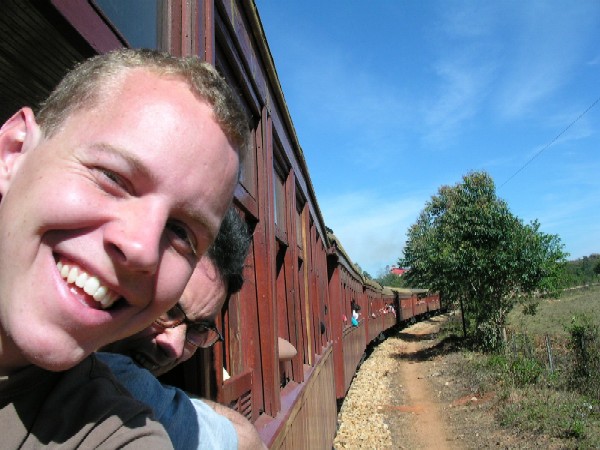
Old Timey Train. I have no idea who that is behind me.
That afternoon we ran across the little town to catch an old steam engine train that would take us for a short scenic ride to the neighboring city of Sao Joao do Rei. It was almost full by the time we got on, but Patricia was bold enough to tell some guys to get their luggage off of the seats around them because we needed to sit down. I recognized them from the seminar. I told her, 'these guys were at the seminar.' And instead of feeling bad because of her browbeating, we all struck up a great conversation as the train rode past cows in their pastures, along a river, along the hills, under a perfectly blue sky. It was a great ride and we all made some new friends with the three anthropologists that had been at the seminar with us.
That's it. We grabbed a taxi back to Tiradentes, got our car and bolted out of there. The drive home seemed never-ending and I ended up barely missing my 6:00 flight back to Brasilia, but that was OK, there was another one leaving at 8:05. As a homeless lady's T-shirt once said "I'm 2 Blessed 2 B Stressed." I didn't sweat missing the flight at all, life was too great this past weekend. The sun set in a deep red sky as we drove above valleys full of the white smoke of smoldering brushfires listening to a lazy female sing a bossanova version of "Let's Face the Music and Dance" on the radio.
Music listened to while writing: Too much to list
Monday, July 7

Ouro Preto
Due to a lack of time and some mild technical difficulties, I am forced the monstrous post full of gorgeous pictures that I hoped to have ready by now. I got back late last night from a magnificent trip to the state of Minas Gerais (which literally means General Mines). I have a fantastic new camera and my soul is bursting with joy thanks to such a great trip. The pictures and story of one of the best weekends of my life will be up by tonight.
Before I sign off completely, however, I'd like to clear up something that I wrote in my last post. I explained that Brazilians consider January and early February to be 'the end of the year' because their year revolves around Carnaval. My friend and colleague, Alessandra, read my post and informed me that this is not entirely true. While the Brazilian year doesn't really begin until after Carnaval, she claims that she still considers December to be the end of the year. She also thinks it's strange that we say 'oh' when referring to the number zero. Yeah...whatever, Alessandra.
One other thing: this site occasionally receives visitors from search engines and I have the privilege of seeing what people are searching for when they are referred to "Homage to Brasilia." Some of the searches are as follows.
* "things to do in brasilia"
* "john basedow sexy"
While this is disgusting, I'm almost positive that this search was performed by Mr. John Basedow himself, which makes this even more disgusting.
* "m83 dead cities mp3"
* "totally blinged"
This one is my favorite because Google provides the following synopsis of my page in their results:
... It was totally blinged out with a bagpiper at the front door, a knighted ambassador to receive me, and several kinds of cheeses, breads, hams and smoked fish. ...
*"portuguese men wearing speedoes in apartment"
*"shakira acoustic"
*"topless ecuadorian models"